Fedorbita
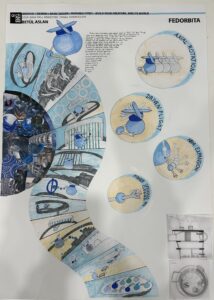
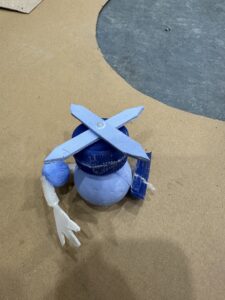
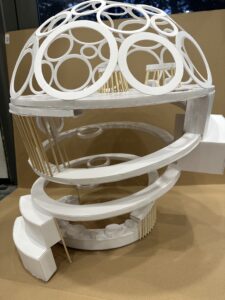
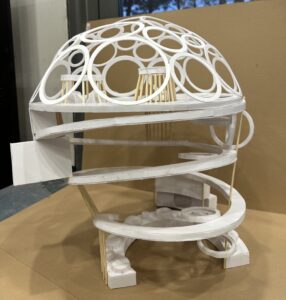
The city is conceived not as a fixed and static structure, but as a dynamic organism that moves, rests, repairs itself, and regenerates in parallel with the daily cycle of its inhabitants. At the center of this organism lies a creation that is not merely placed within the city, but functions as the fundamental force that activates it. Its movements determine the city’s paths, spatial relationship, and vertical organization.Fedorbita is designed as a vertically rising, layered system. The upper levels consist of semi-open spaces where the creation moves, observes, and initiates repair processes. When the creation awakens, its rotating mechanism triggers motion throughout the entire city and enables the circulation of fluid flows within the structures. These flows become both a vital source of energy that sustains life and a defining element of the city’s structural language. To repair its damaged propeller, the creation follows a defined path leading to the repair zone. These paths extend downward in a spiral form toward the abstracted city below, shaped by the flight movement of the orbita. Along this route, fluids activated by the city’s motion are transported through pipes to energy collection areas. In open spaces, the creation observes the city and distributes probability spheres across the urban fabric to support the repair process.After completing its task, the creation retreats into a heavier and more enclosed space in order to clean and repair itself. At the end of the day, it follows the path defined by circular elements and returns to the sleeping colony.The spatial atmosphere and perception of the city change in accordance with its vertical organization. The lower levels are designed as dense, enclosed spaces with a heavy, stone-like character. These areas collect fluids, store energy, and convey the darker and heavier identity of the city. As one moves upward, the architectural language becomes lighter; semi-open and open spaces increase, voids expand, and the city begins to establish a relationship with the sky. This vertical transition allows the city to experience not only a physical, but also a sensory lightness.From the perspective of a user living in Fedora, everyday life is shaped by the rhythm of the creation. Movement within the city is guided by the paths it follows and the pauses it takes. One awakens as the city gradually comes to life, observes the flow of energy through the structures, and retreats to calmer spaces as the creation enters its resting phase. In this city, architecture is experienced not merely as a place to inhabit, but as a living system that moves, breathes, and evolves together with its creation.