POST-LEONIA
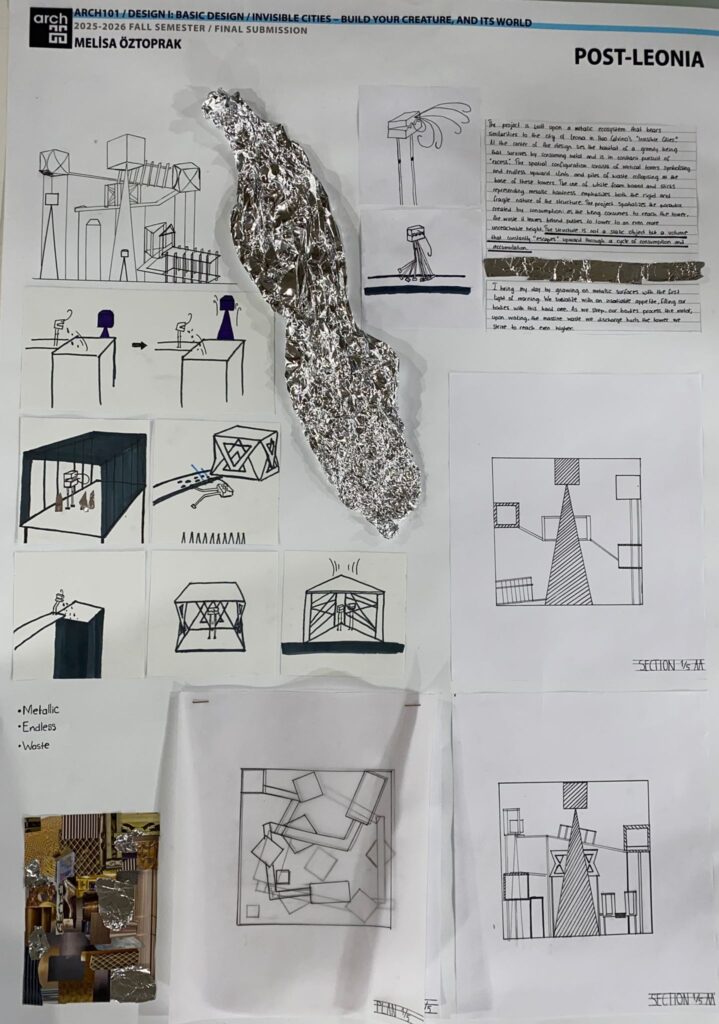
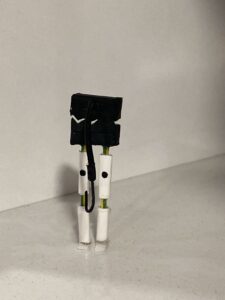
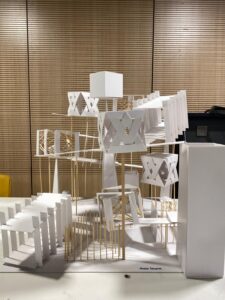
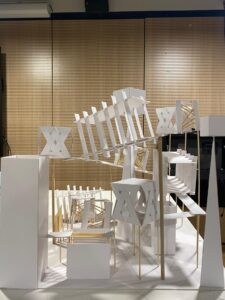
The project “Post-Leonia” explores a dystopian urban cycle inspired by the concept of eternal consumption and the paradoxical nature of ambition. In this reimagined city, the inhabitants—depicted as voracious, mechanical entities—are driven by a single, insatiable desire: to reach the monumental towers that dominate the skyline. These towers represent an ultimate status or a transcendental goal, yet the very actions the creatures perform to reach them ensure that the towers remain forever out of grasp. The daily existence in Post-Leonia is a relentless, repetitive loop. The day begins with a ritual of consumption; the creatures eat to fuel their existence, followed by a period of socialization. During these social interactions, the primary focus is not connection, but strategy. They gather to contemplate how to overcome the physical barriers that obstruct their paths toward the towers. However, this contemplation is a trap of the mind. Once they retreat to sleep, the true irony of their existence manifests. As they rest, they produce waste—a physical byproduct of their daily consumption and metabolic existence. The core paradox of the city lies in its waste management. Every time the inhabitants dispose of their refuse, the piles of waste accumulate, ironically causing the very towers they desire to appear further away or grow taller in proportion to the rising ground of trash. The more they consume and “cleanse” their immediate surroundings, the more they extend the distance between themselves and their goals. The spatial organization of Post-Leonia is designed to deceive. Upon exiting the eating areas, the inhabitants are met with a visual illusion: the path ahead seems to lead directly to the base of the great towers. This architectural manipulation creates a false sense of progress, fueling a perpetual motivation that leads nowhere. The city is a treadmill of aspiration where the finish line recedes with every step taken. Visually and structurally, the project is built upon a language of contrast. The architectural forms are characterized by sharp, aggressive edges and metallic textures, reflecting the harshness of a society driven by greed. While the city’s aesthetic suggests strength and permanence, its structural logic is fundamentally fragile. Because the city is obsessed with vertical growth and “climbing,” the foundations are precarious, built upon the shifting mounds of its own discarded history. This duality—the hardness of the metallic surfaces versus the fragility of the vertical ambition—serves as a critique of modern consumerist cycles. In conclusion, Post-Leonia is not just a city of waste, but a city of tragic illusions. It is a place where the inhabitants are prisoners of their own greed, trapped in a loop where consumption is the engine and waste is the architect of their eternal distance from the towers they worship.