REMNANT & THE MEMORY CATCHER
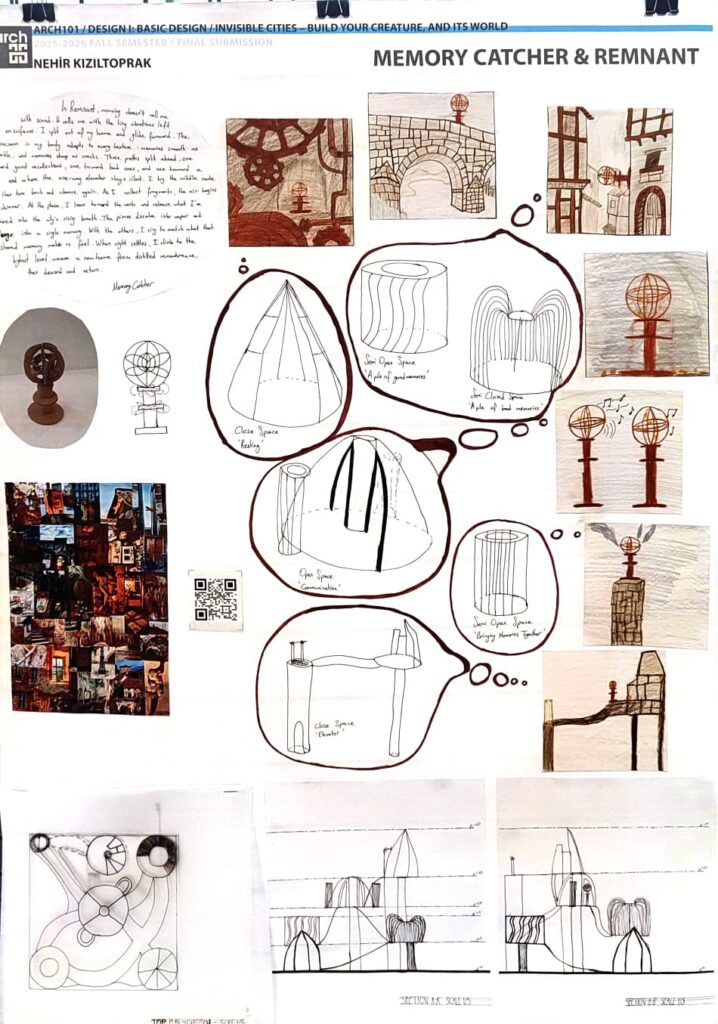
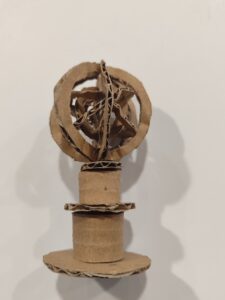
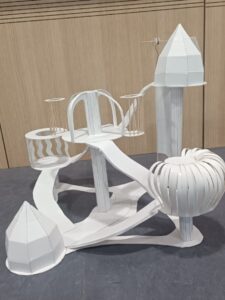
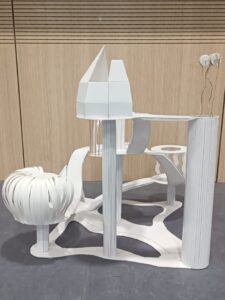
Remnant is a living system shaped not by physical expansion, but by the accumulation of memories. Drawing inspiration from Italo Calvino’s Invisible Cities, especially the city of Zaira, the project treats memory not merely as a record of the past, but as an active force that produces and transforms space. In Remnant, architecture does not “store” memories in a static way; it continuously adjusts, filters, and redistributes them. Layered platforms, voids, and spiral/diverging paths represent the fragmented nature of remembering. Vertical continuity and the central ventilation/vent system form the city’s “breathing” side: an infrastructural mechanism that vaporizes memory fragments and condenses them into a single shared memory. This structural language is built on fragility, repetition, and transformation because memory itself is not fixed, but rewritten every day. The key agent that sustains this system is the Memory Catcher. As the cylindrical modules on its body rotate, they activate a vacuum mechanism that allows it to cling to any surface; the same motion also enables it to absorb and collect memory fragments embedded in the city’s material layers. The collected memories are not perceived by their form, but by emotional intensity: some feel smooth and light, others sharp and heavy. The city’s three branching routes therefore represent more than directional choice; they operate as a filtering order between good memories, bad memories, and forgetting. One-way or inaccessible routes reveal that the architecture deliberately produces conditions of “forgetting.” From the Memory Catcher’s perspective, everyday life in Remnant becomes a cyclical ritual. Each morning it leaves its triangular shelter and chooses one of the three paths; sometimes it tests the middle route and returns in the one-way silence of the elevator. In the zones of good or bad memories, it harvests fragments from surfaces and reaches the plaza. There, through the vents, the fragments rise, vaporize, and merge into a single shared memory. With other Memory Catchers, it communicates by singing according to what that shared memory makes them feel. At night it climbs to the upper level, completes a new shelter from distilled memories, and then descends by the elevator to return home. In this way, Remnant is never a finished city: it strengthens through what is remembered, creates voids through what is forgotten, and continuously rebuilds itself.