HORAS The Invisible City of Zaira
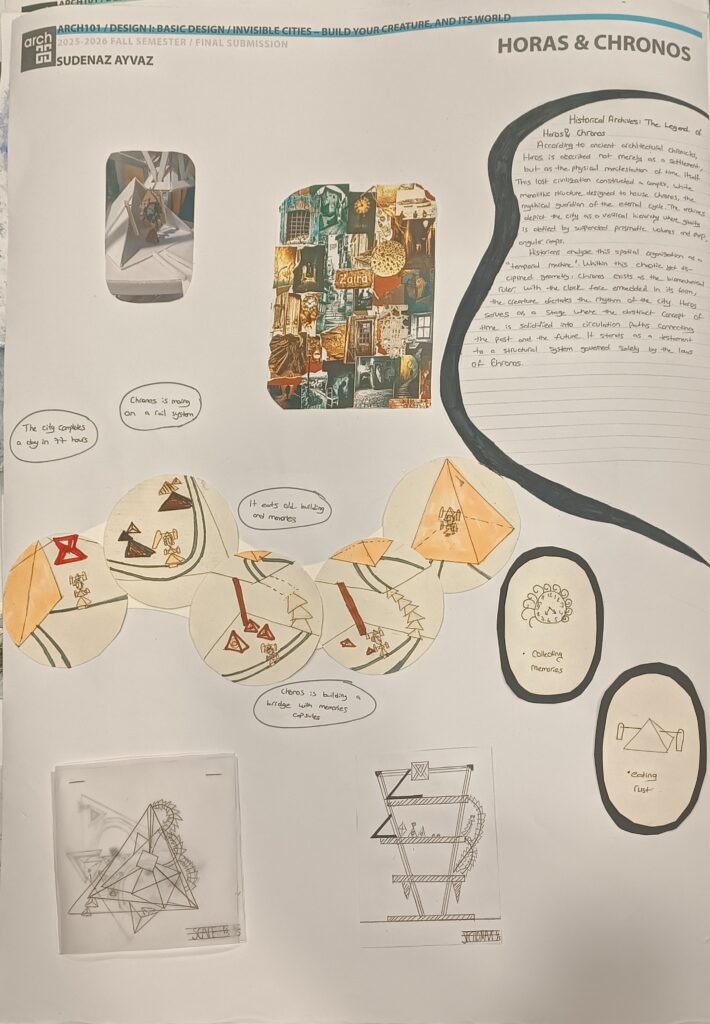
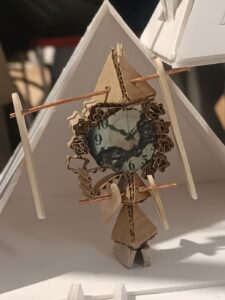
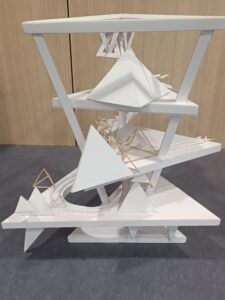
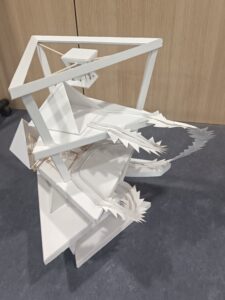
Inspired by the Invisible City of Zaira, Horas is a temporal city governed by memory, decay, and repetition. At the center of this system exists Chronos, a mechanical creature that feeds on memories, rust, and architectural remnants from abandoned structures. Chronos does not erase the past; instead, it processes it, transforming time into an architectural cycle. Horas is organized in a triangular form and operates on a 77-hour temporal loop, after which all processes reset and begin again. This loop defines both the spatial and conceptual structure of the city. Horas consists of four vertical layers, including an underground level, each representing a different stage of memory and transformation. Chronos awakens at the uppermost level and descends along a rail-based system that connects all layers through bridges. Its movement is slow and repetitive. As Chronos collects memories from old structures, the coils surrounding its clock-shaped head gradually contract, visually recording accumulation. Once complete, these coils detach and ascend to the upper layer of the city, transforming into memory capsules. Memories within Horas are classified into two types: positive andnegative. Positive memories are preserved and transported upward to a memory capsule repository, where they remain suspended as architectural artifacts. Negative memories are condemned and dropped through a central void into the underground layer, a compressed and dark zone where unwanted memories are buried. A critical architectural element of Horas is the broken bridge connecting the city to Chronos’s dwelling. This bridge can only be reconstructed through accumulated memory capsules, making memory both material and structure. Circulation between layers occurs exclusively through rail-embedded bridges, reinforcing the idea that movement, time, and memory are inseparable. Through its endless 77-hour cycle, Horas exists as a city that never truly progresses, only repeats, preserving memory as burden and resource.