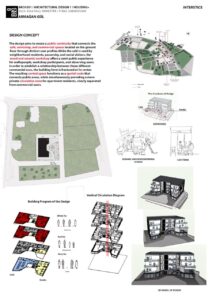
This project is a mixed-use social housing development designed for young urban residents who seek a balance between individual living, social interaction, and creative production. Located in Kayseri, within an urban context shaped by a dense young population and student life, the project aims to provide a stable housing model that is used throughout the year. By bringing production and living practices together under one roof, the building proposes an alternative to conventional apartment typologies.
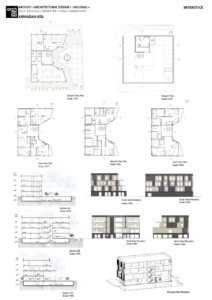
The main spatial concept of the project is based on a layered organization that separates different levels of use and privacy. The ground floor is conceived as a public and semi-public interface between the building and the city. This level accommodates two workshop spaces with fixed production disciplines: ceramic and wood workshops. The workshops are spatially connected yet differentiated according to their specific production requirements. Due to the presence of kilns, the ceramic workshop is positioned in a more controlled corner of the building and is divided into wet and dry areas in order to ensure a safe and organized working process. The wood workshop, on the other hand, is designed as a more open and flexible production space.
The workshop areas are not conceived as flexible spaces that constantly transform according to changing events, but rather as curatorial working environments with a fixed production layout. This approach allows the architectural character of the space to remain consistent while enabling the produced works and production processes to evolve over time. The ground floor also includes a café space for both residents and visitors, functioning as a social meeting point that supports everyday interaction. The works produced in the workshops are not transferred to a commercial sales area and are addressed within a purely production- and experience-oriented framework.
Above the ground floor, an intermediate level is dedicated to shared working spaces, creating a transitional and buffering layer between social intensity and residential areas. The upper floors accommodate only residential units, with no micro studio typologies included. This design decision aims to provide a higher level of privacy and a calmer living environment for residents. The residential units are designed in 1+1, 1.5+1, and 2+1 typologies, supporting year-round living for young professionals, long-term students, freelancers, young couples, and a limited number of small families.
Interstice proposes a community-oriented social housing model that responds to the needs of contemporary urban life by clearly separating productive workshop spaces from calm and stable residential areas.