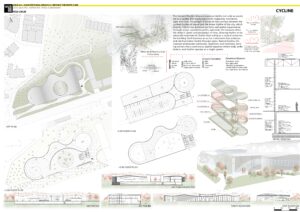
CYCLINE – Sensory Rhythm Museum / NİSA OKUR
CYCLINE – Sensory Rhythm Museum is an experiential museum project that explores rhythm not only as a sonic phenomenon, but as a multidimensional relationship between space, body, and time. Inspired by the cyclical nature of rhythm in human perception, the project invites visitors into a continuous spatial flow rather than a linear exhibition sequence.
The museum aims to make sensory interaction visible through architecture. Sound, light, movement, and tactile perception are integrated with form, circulation, and spatial voids, allowing rhythm to gain a physical presence. Instead of rigid boundaries, the building is shaped through soft transitions, curved surfaces, and flowing spatial sequences that reflect the repetitive yet ever-transforming structure of rhythm.
CYCLINE positions the visitor as an active participant rather than a passive observer. As one moves through the museum, different levels of sensory intensity are experienced; some spaces accelerate perception, while others slow it down. This shifting tempo continuously redefines the relationship between the body and space, encouraging awareness and reflection. Movement becomes a tool for sensing rhythm, and the architectural journey itself turns into an exhibition.
The relationship between the building and its surroundings is also conceived as part of this rhythmic system. The landscape is not treated as a background element, but as an extension of the museum’s sensory narrative. Natural and built elements interact to sustain continuity between interior and exterior experiences, reinforcing the concept of rhythm beyond enclosed spaces.
Ultimately, CYCLINE transforms rhythm from an object to be displayed into a spatial experience to be felt. Through architecture, rhythm becomes something that is perceived, inhabited, and remembered. The project proposes a museum that communicates through the senses, offering visitors a dynamic and immersive encounter with rhythm as a living and cyclical phenomenon.