ROOTS-MUSEUM / BÜŞRA TEMİR
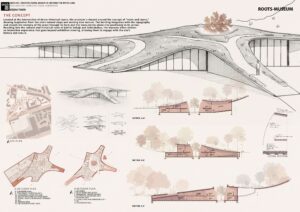
Located on the Dolmabahçe–Şairler Street axis, where Istanbul’s historical depth intersects with its modern urban fabric, this museum design is conceived as an “urban articulation” that reproduces urban voids rather than consuming them through built mass. The main philosophy of the project is grounded in the concept of “roots,” referencing the collective memory of the place and the layered structure of the ground itself.
The idea of the museum emerged from a desire to delve into the historical and cultural roots of this valuable site and to bring its hidden narratives to the surface. Its formal language is derived from the organic, interconnected, and spreading structural logic of roots. The design functions not only as an exhibition space but also as a physical bridge that connects two distinct levels and urban characters.
The project’s most fundamental architectural gesture is the decision to avoid creating a solid, enclosed mass on this precious land; instead, the roof is transformed into a fully walkable public platform that is given back to the city. In this way, the museum does not occupy urban space, but rather offers a new topography—one that can be walked upon, inhabited, and socially activated, allowing the city to be experienced from multiple perspectives.
While the interior exhibition route embodies the depth and silence of roots, the exterior culminates in a ground plane that integrates with the dynamism of the city. Ultimately, the building establishes an architectural dialogue that is grounded, respectful, and fluid—bridging the roots of the past with the public life of the future.