SHARED LAYERS / AYNUR GÖKEN BIYIKLI
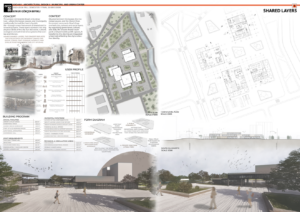
The “Shared Layers” design approach redefines the municipal building not as a singular, closed administrative object, but as a layered spatial system where public, semi-public, and institutional uses overlap and interact. This concept emerges from the idea that contemporary local governance should operate not only as a service provider, but also as an active and accessible component of everyday urban life.
Rather than organizing the project through rigid vertical separation, the layers are defined by degrees of accessibility, permeability, and public engagement. The ground level is conceived as the most public layer, directly engaging with the city through a massing strategy and landscape design that guides citizens toward an internal courtyard and brings together public functions with recreational spaces in a shared spatial framework. Functions such as the public foyer, city council-related spaces, exhibition areas, and co-design or shared working spaces are located at this level, allowing the building to function as an extension of the urban realm rather than a controlled threshold.
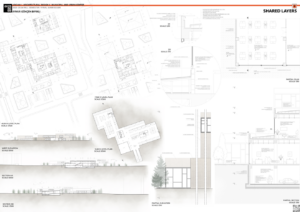
Upper layers accommodate the administrative and technical units of the municipality. These spaces are organized to maintain visual and spatial relationships with the public layer below, avoiding a detached or hierarchical institutional character. In this way, governance remains physically elevated yet conceptually connected to public life. The relationship between layers is strengthened through internal voids, semi-open courtyards, and transparent façade strategies, which enhance orientation, visibility, and spatial continuity throughout the building.
The “Shared Layers” approach positions the municipal complex as more than an efficient administrative mechanism; it becomes a participatory, transparent, and inclusive civic platform. By enabling different user groups to coexist within a continuous spatial structure rather than isolated zones, the project fosters interaction, accessibility, and civic awareness. Architecture thus acts as an interface between governance and citizens, transforming the municipal building into a visible, approachable, and integral part of the urban fabric.