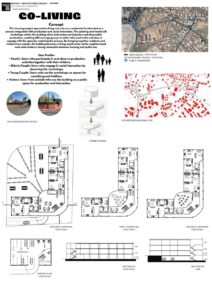
The CO LIVING project is conceived as a contemporary shared living environment that integrates housing, social interaction, and collective production. The project aims to redefine conventional residential typologies by emphasizing community life and shared creativity rather than isolated private living. Through its spatial configuration, the building encourages interaction, collaboration, and a strong sense of belonging among its users.
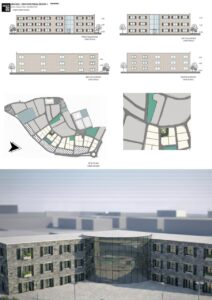
The architectural form is organized as an L-shaped building, which creates a defined courtyard and establishes a clear relationship between built mass and open space. This configuration allows the project to frame a semi-public outdoor area that supports social activities while providing controlled access and privacy. The L-shape also enhances natural ventilation and daylight penetration, improving the overall spatial quality of both interior and exterior spaces.
At the intersection of the two wings, a transparent glass volume functions as the communal core of the project. This central space accommodates shared art and craft workshops, making collective production a visible and integral part of daily life. The openness of the glass atrium strengthens visual connections across different floors and encourages users to participate in communal activities. By positioning these shared functions at the heart of the building, the project prioritizes interaction and accessibility.
Private living units are located along the wings of the L-shaped form, ensuring a balance between privacy and community engagement. Circulation areas act as transitional zones, gradually shifting from private to semi-public and fully public spaces. This layered spatial sequence supports spontaneous encounters and informal social interaction throughout the building.
Material choices reinforce the conceptual framework of the project. Solid stone façades express permanence and stability, while the glass core represents transparency and collective life. Together, these elements create a coherent architectural language that reflects the project’s social intent.
In conclusion, the CO LIVING project proposes an alternative housing model where living, creating, and sharing coexist. The L-shaped form and centrally located communal spaces support a sustainable and socially engaged way of living, encouraging residents to live together and create together.