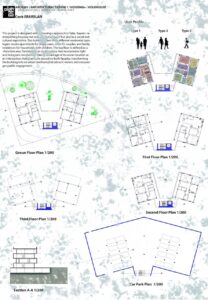
HOLOHOUSE is a Housing+ project that explores the integration of residential life with art, digital media, and experiential spaces. The project is designed as a contemporary housing complex where living spaces are not isolated from cultural production, but instead actively interact with it. The main idea is to create a hybrid environment in which daily life, art, and technology coexist and enrich one another.
The project consists of two residential blocks organized around shared circulation and collective spaces. While the lower and middle floors function primarily as residential units, the upper level is designed as an art gallery open to both residents and visitors. This gallery space hosts hologram installations, digital artworks, and live painting activities, transforming the building into a constantly changing visual interface. In this way, the building becomes not only a place to live, but also a platform for artistic expression and public interaction.
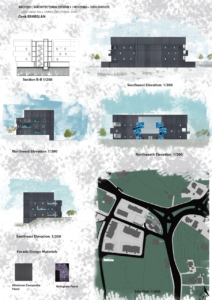
Architecturally, HOLOHOUSE emphasizes permeability and visual connectivity. Transparent and semi-transparent surfaces allow the activities inside the building to be perceived from the outside, blurring the boundary between private and public realms. The façade design combines aluminum composite panels with hologram panels, creating a dynamic appearance that changes depending on light conditions and viewing angles. At night, the holographic elements enhance the building’s identity and reinforce its role as an urban landmark.
The Housing+ concept is reflected in the project’s focus on shared experiences rather than purely individual living. Common areas, galleries, and circulation spaces are designed to encourage encounters between residents, artists, and visitors. By integrating art directly into the residential program, HOLOHOUSE proposes an alternative housing model that supports creativity, social interaction, and cultural continuity.
Overall, HOLOHOUSE aims to redefine housing as an experiential environment where architecture acts as an interface between living, art, and technology.