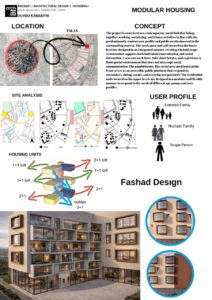
The project is conceived as a social focus that brings together working, socializing, and resting functions in response to the predominantly student-oriented user profile and the public needs of its surrounding context. Rather than functioning as an enclosed and isolated structure, the building aims to establish a strong relationship with its environment and become an active part of everyday urban life.
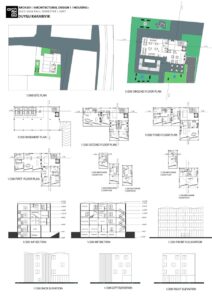
The workspace and café located on the lower level are designed as interconnected spaces rather than separate functions. This integrated layout supports both focused individual work and informal social interaction. In addition to providing areas for long-term concentration, the spaces allow users to take short breaks, socialize, and engage in daily encounters. Thanks to the fluid spatial relationship between these functions, transitions between working and resting occur naturally, without interrupting social communication.
The amphitheater-like area positioned on the front façade is considered a key open space that strengthens public use. This area accommodates sitting, waiting, spontaneous encounters, and small-scale events, reinforcing the building’s relationship with its surroundings. As a space open to everyday use, it emphasizes the project’s public character.
The residential units located on the upper levels are designed with a flexible approach in order to respond to different user profiles and lifestyles. In addition to standard housing types, the project includes loft and duplex units that offer varied spatial experiences. While duplex units provide vertically organized living spaces suitable for users with greater spatial needs, loft units with double-height interiors and open-plan layouts appeal especially to students and young users seeking flexible and contemporary living environments. Through this diversity of unit types and adaptable spatial solutions, the housing component is able to respond to changing needs over time and support different ways of living.