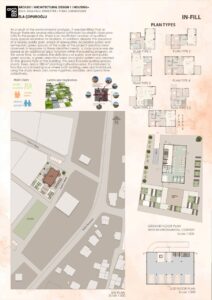
As a result of the environmental analyses, it was identified that although there are several educational institutions located in close proximity to the project site, there is a lack of sufficient and qualified study spaces for students. Most of the existing public spaces in the area are mainly designed for circulation or short-term use, and they do not adequately support long-term studying or social interaction. In addition, even though there is a public park near the site, it was observed that this park is not used effectively due to dense surrounding development and accessibility issues. This situation highlights the need for accessible public and semi-public green spaces at the scale of the project area.
In response to these needs, a study space was designed as an additional (plus) function within the building program. This space is intended not only for students but also for local residents, creating a flexible environment that supports individual study, group work, and collaborative activities. In this way, the building is transformed from a purely residential block into a social focal point within its context.
To address the lack of public and semi-public green spaces, a ground-floor green area structured on a gridal system was created. This area includes seating spaces, dense planting, trees, and a 180 m² planting/urban cultivation area. The green space is designed to function as a shared social zone where both building users and study space users can come together, interact, and spend time collectively.
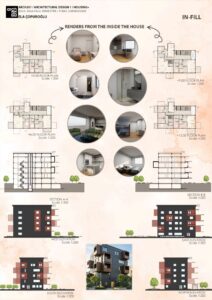
The residential units were designed to respond to different user profiles. In total, the building includes six different plan types: three 1+1 units, one 2+1 unit, and two 3+1 units. This variety aims to provide a flexible and inclusive housing model that accommodates diverse living scenarios and household types, contributing to the overall sustainability and social diversity of the project.