Living Ornament
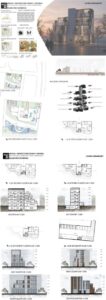
The Living Ornament project explores housing as a dynamic system where daily life, nature, and spatial experience are interwoven. Rather than treating ornamentation as a decorative layer, it is reinterpreted as a living, spatial, and environmental component shaping both building form and user experience.
The project is based on the concept of “Inhabited Pattern,” inspired by natural growth, water systems, and human movement. Here, ornamentation emerges through use, circulation, and ecological interaction, shaped by programmatic needs, spatial flow, and environmental conditions rather than being applied after the form is defined.
Site and Context
Environmental and contextual analyses—such as land use, road networks, building heights, and user profiles—guided the placement and massing of the building. The design responds to its urban context by maintaining permeability at the ground level and creating visual and physical connections between open, semi-open, and interior spaces.
Program and Spatial Organization
Living Ornament is designed as a Housing+ project, combining residential units with shared and productive spaces. The building program includes:
- One-bedroom, two-bedroom, and three-bedroom apartments
- An ecology workshop
- Common circulation and social spaces
- An ornamental water pool integrated into the landscape
The vertical organization of the building allows different programs to interact through shared circulation cores, terraces, and visual connections. The ground floor is designed as a semi-public zone, encouraging interaction between residents and the surrounding environment, while upper floors gradually transition into more private living spaces.
Form Development
The building form was developed through a process of form finding rather than form imposition. Based on site conditions and programmatic requirements, the mass was shaped by movement, daylight, and interior–exterior relationships. The stepped façade creates terraces that extend living spaces and reinforce the concept of a “living” ornament.
Sectional and Environmental Approach
Sectional studies were essential in shaping spatial quality. Variations in floor heights, vertical connections, and façade articulation enhance natural light and ventilation. The ornamental pool and landscape elements support microclimatic comfort and strengthen the project’s ecological narrative.
Conclusion
Living Ornament proposes an alternative understanding of housing where ornamentation is no longer an applied aesthetic element but a spatial strategy that supports social interaction, ecological awareness, and everyday life. By integrating program, form, and landscape, the project aims to create a living environment that evolves with its users and remains responsive to its context.