İLAYDA SAVAŞ
RISE THROUGH ART
Project Explanation Report
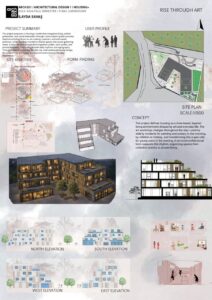
This project proposes a Housing+ model that rethinks residential architecture as a dynamic system shaped by art, everyday life, and social interaction. Rather than treating housing as a purely private function, the design integrates collective and productive spaces that respond to changing user groups and time-based activities throughout the day.
The project is located in a transitional urban context near Talas National Garden, where residential life intersects with public movement along the main street. Site research and observations revealed a strong daily rhythm: calm and individual use in the mornings, increased activity during the afternoon, and social gathering in the evenings. These temporal changes directly informed both the architectural scenario and spatial organization of the building.
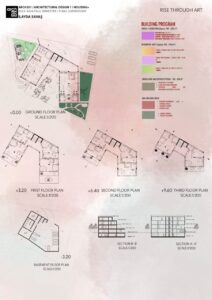
At the core of the proposal is the art workshop, conceived as a flexible and transformative space. In the mornings, elderly users gather for painting and pottery in a calm and focused environment. During midday, children activate the space through creative activities. In the evenings, the workshop transforms into a quiz café, where young residents and visitors come together. This social setting is supported by a small bar area, allowing participants to experiment with different beverages as part of the collective experience. Through this transformation, artistic production extends beyond making and becomes a shared social practice.
Complementing the workshop, the Clay Garden operates as an outdoor, soil-based production space. Although physically separate from the workshop, the two are conceptually connected through a shared narrative of material transformation—from raw soil to ceramic objects and social exchange. This separation helps preserve residential privacy while reinforcing continuity within the artistic process.
The front garden, positioned directly along the main street, acts as an active urban interface. During the day, it functions as an open working and exhibition space, where artworks and ceramic production are visible from the street. This visibility strengthens the relationship between the project and its surroundings, allowing art to become part of everyday urban life.
Architecturally, the building is shaped through a terraced massing strategy, allowing spaces to rise gradually from public and semi-public functions to private residential units. This stepped configuration improves daylight access, creates usable terraces, and establishes a visual dialogue with the layered silhouettes of traditional Kayseri houses in the surrounding landscape.
Materially, the project combines exposed concrete, glass, wood, clay, and local stone, balancing structural clarity, transparency, warmth, and contextual continuity. Through this integrated approach, the project frames housing as a living and evolving environment, where making gathering, and dwelling are continuously intertwined.