PROJECT EXPLANATION REPORT
Name Surname: MERVE NECLA ÖZTÜRK
Project Name: THE HOUSE OF NEUGHBORS
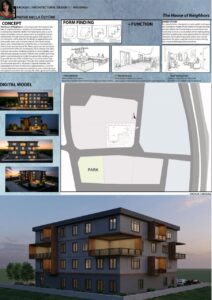
This project addresses the increasing individualization and spatial disconnection in contemporary housing production by rethinking housing not only as a place of shelter, but as a system that supports social interaction and collective living. The Housing+ approach proposes a residential model strengthened by shared and encounter-oriented spaces, allowing different user profiles to coexist and interact.
The project site was analyzed in relation to its surrounding built environment, street connections, and pedestrian–vehicle circulation. Based on these analyses, the building was designed with an L-shaped form, which creates a semi-public central courtyard-like plaza within the site. This void functions as a shared open space that encourages daily encounters and social interaction among users. The permeability of the ground floor and its direct relationship with open spaces strengthen the connection between the building and its urban context.
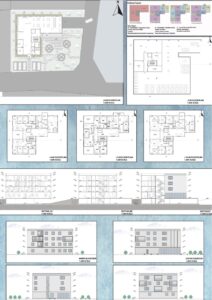
The floor plans were developed to support user diversity, resulting in eight different housing unit typologies, each tailored to a specific user profile. Rather than imposing a single lifestyle, the project offers a flexible residential system capable of responding to varying needs. These diverse housing units are brought together on each floor through shared spaces that enhance interaction.
On every floor, two housing units share a common terrace, which acts as an interface between private and communal spaces and encourages informal socialization. In addition, seating areas located in the floor halls are designed to increase encounters and interaction at the floor level. These spaces function as social nodes within the vertical circulation system. Shared kitchens on the residential floors further reinforce this interaction by bringing users together through everyday activities.
An additional key design decision is the placement of a shared kitchen on the ground floor. This space is directly connected to the central plaza and public open areas, making the idea of sharing visible at the most public scale of the building. The ground-floor shared kitchen is conceived as one of the main social focal points, where different user groups can come together and interact.
The form-finding process was shaped through mass fragmentation, setbacks, and the emphasis on shared open spaces. Courtyards, terraces, and the central plaza collectively form the social backbone of the project. Overall, the proposal aims to present an interaction-oriented housing model that is both responsive to its urban context and focused on enhancing user experience.