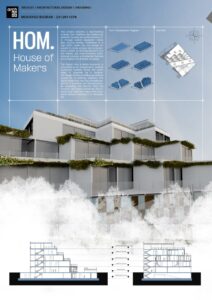
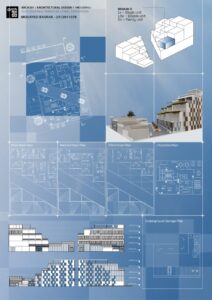
This project explores a contemporary housing model integrated with a publicly accessible complementary function, responding to both the physical conditions of the site and the social dynamics of its context. The design uses terraced massing as a primary strategy to create a gradual transition between public, semi-public, and private spaces.
The residential building is organized in stepped volumes, allowing each level to benefit from outdoor spaces, natural light, and visual connections. The roof is conceived as an extension of the ground, transformed into an accessible terrace that functions as a shared social platform for residents and visitors. Seating stairs and ramps are not treated merely as circulation elements but as active spatial components that encourage pause, interaction, and informal gathering.
A secondary, detached building accommodates the project’s additional function, reinforcing the idea of mixed-use development while maintaining a clear distinction between residential privacy and public activity. The façade system reflects this layered organization: wooden panels act as a curtain wall element, providing solar control and visual rhythm, while neutral materials and restrained color tones emphasize clarity and coherence.
The project prioritizes flexibility, everyday usability, and spatial continuity rather than iconic form. By reinterpreting circulation, roofs, and transitional zones as inhabitable spaces, the design proposes a housing environment that supports social interaction without compromising privacy. Overall, the project aims to demonstrate how architectural form, program, and movement can work together to create a balanced relationship between individual living and collective urban life.