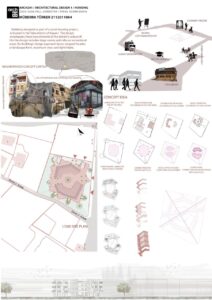
The Sideland housing project, located in the Bahçelievler neighborhood of Talas, is situated in an area characterized by the mountainous terrain of Talas and traditional structures. While its demographic structure is considered a student-heavy area due to the established university and dormitories, room scenes have been defined as a concept to address the lack of living culture.
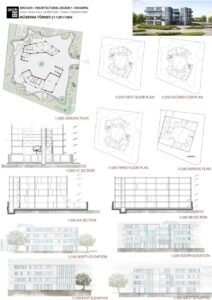
The project has played an active role in the seating area shape, mass, and landscape design. Recesses and projections have been created in the landscape and building form according to the narrowing and widening points of the area. To maximize the interaction of the project with its defined form, it was solved in two blocks, creating a courtyard. In the project, where uninterrupted circulation from the entrance of the area was considered a landscape design decision, the courtyard stands out as an important interaction area. The purpose of the maximum facade width in the apartment blocks is to take maximum advantage of the views created by Ali Mountain and the site area. Additionally, the connection between the blocks has been designed with a corridor and a view of the courtyard. This design ensures that the project apartments receive maximum light from every facade. At the same time, this design ensures that each room has its own balcony, creating a strong connection with the surroundings and views. To avoid the amorphous mass effect in the balcony design, a method of pulling and protruding was used, as seen in the form. Sharp corners were integrated with the landscape and made wavy. This movement has ensured that the common area balconies are wider, while the private rooms have balconies that are relatively narrower.
The building, which has 2 apartments on each block floor, has 4 floors including the ground floor, except for the 3rd floor, and consists of 13 apartments. The interior design of the apartments has been solved in various ways according to the user profile. The first block floor consists of two 2+1 apartments, one 3+1 apartment, and one 1+1 apartment. The second floor consists of three 2+1 apartments and one 1+1 apartment. The third floor consists of three 1+1 apartments, one 2+1 apartment, and one 3+1 apartment. The closed parking lot form was created by defining its boundaries based on the projection of the structure, which was resolved in two cores. The shelter solution, water storage, technical, and electrical room solutions were resolved in the closed parking lot.