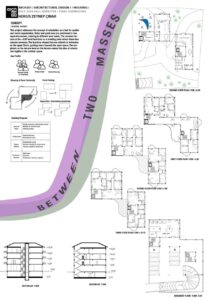
This project explores the concept of Housing+ as a spatial and social model that goes beyond conventional residential use by integrating shared and community-oriented functions into everyday living. Located in Kayseri, the project responds to its urban context by proposing a housing environment that balances privacy with collective interaction. The main aim is to create a livable residential setting where social encounter, orientation, and continuity are integral parts of daily life rather than secondary additions.
The design is structured around the concepts of separation, orientation, and continuity. Noisy and quiet functions are separated into two distinct masses to accommodate different user needs. While the quieter mass mainly hosts residential units, the other includes more active and social uses. These two masses are not isolated from one another; instead, they are connected through a shared terrace at the +3.85 level. This terrace acts as a social hinge where different user groups intersect, encouraging interaction while maintaining spatial clarity.
Spatial organization plays a crucial role in reinforcing the Housing+ idea. The ground floor accommodates shared and semi-public functions, supporting social engagement and collective use. Upper floors contain residential units designed for different user profiles, including nuclear families, young couples, and student housing. The shared terrace extends vertically through teardrop-shaped balconies on the upper floors, guiding users visually and physically toward the open spaces and strengthening orientation within the building.
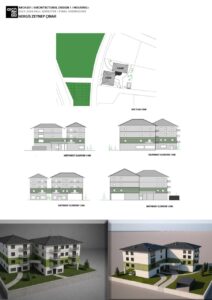
The architectural language of the project emphasizes this continuity between shared and private spaces. The terrace level is clearly expressed on the façade through a horizontal band, making the social core of the building legible from the exterior. This visual expression not only reflects the internal organization but also reinforces the idea of Housing+ as a model where collective spaces are visibly celebrated. Overall, the project proposes a housing approach that supports social interaction, spatial clarity, and adaptable living while responding sensitively to its context.