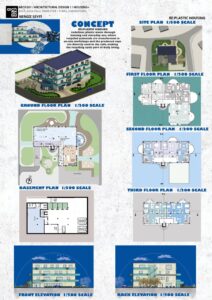
In this project, I approached recycled plastic not only as a construction material but as a visible architectural element that can be perceived from the outside and constantly remind users of the recycling process. My main aim was to make recycling visible instead of hiding it behind facades, and to integrate this idea into everyday life through housing. The project was developed within the scope of the ARCH201 Housing+ studio, combining residential use with a community-oriented + function.
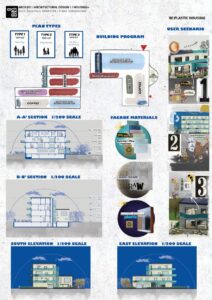
During the design process, I mainly focused on balconies. Instead of treating them as passive or secondary spaces, I wanted to make balconies the most noticeable parts of the building. For this reason, I wrapped and emphasized the balconies with facade elements made of recycled plastic and pushed them outward to make them more visible. In this way, the facade becomes more than just a building envelope and starts to communicate the idea of sustainability directly. The project includes three different housing types. The first type is designed for family use and offers a larger and more flexible layout. The second type is more compact and responds to smaller households. The third type is designed as a duplex unit and allows different living scenarios. With these three housing types, I aimed to bring together different user profiles within the same building. I also designed the vertical circulation to be clearly visible from the outside. I placed the spiral staircase and the elevator outside the main building mass and covered them with recycled plastic material. This decision allowed both movement and material use to become readable on the facade.
As the + function of the project, I designed an open mini lab, exhibition spaces, and a workshop. In the workshop, cups made from recycled plastic are produced, and I aimed for these cups to be both sold and actively used in the café on the lower floor. In this way, I created a continuous cycle between production, use, and exhibition. Through this project, I aimed to turn recycling from an abstract idea into a process that users can directly experience in their daily lives.