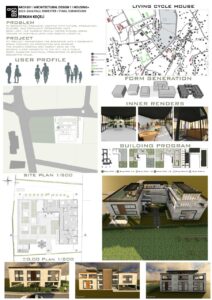
Living Cycle House was designed as a response to the increasingly weakening relationship between nature, production culture, and social interaction in contemporary residential life. Residential projects designed in recent years have encouraged people to adopt an inward-looking lifestyle, while also largely preventing them from growing their own natural produce in their gardens. The Living Cycle House project aims to rethink housing not only as a shelter but also as an active, social, and productive part of the life cycle.
Looking at the project’s most fundamental approach, it creates a spatial concept in the Talas district of Kayseri, an area with almost no agricultural land, that reconnects people with agriculture and aims to strengthen social relationships. Shared agricultural areas, both soil-based and soil-free, integrated into the housing structure become part of everyday life, transforming production into a collective experience. In this project, agriculture is not merely a production activity; it is a social tool that brings users together and encourages interaction and sharing.
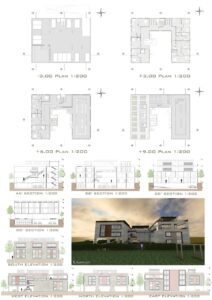
Upon reviewing the project plan, we see that a courtyard has been designed in the middle section of the U-shaped form, and one side of the form has been cut off at ground level and designated as an agricultural area. At the same time, several retail units in this area meet the needs of the people. Designed for a plot of land near a park on the west facade and a street connecting to the main road, the project encourages interaction and experimentation with transition areas. Vertical farming units located in the corridors of the living areas allow residents to enjoy this experience in their own spaces. Visitors can reach the soil-free vertical farming areas on the 2nd and 3rd floors via a surprising staircase extending vertically from the courtyard in the central area and participate in this experience with their own farming kits. Furthermore, this social interaction increases even more as they pass through the residential corridors during this circulation. There is also a salad bar on the top floor serving products grown in the Living Cycle House gardens.
Finally, Living Cycle House creates an alternative housing model that combines living, production, and social interaction. This approach, which places agriculture at the center of daily life, offers a sustainable and community-focused lifestyle, creating a life concept that grows around agriculture.