Velorum in Nervuria
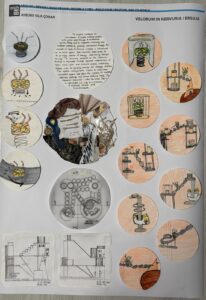
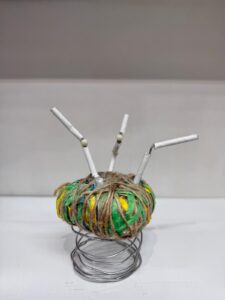
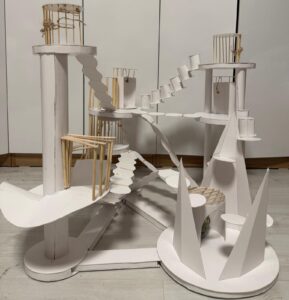
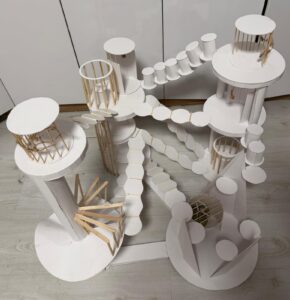
The creature’s daily routine is shaped by movement, rhythm, and spatial hierarchy. Each morning begins inside its dwelling, a protective core that allows rest before action. Movement starts with jumping, which is not merely a physical ability but the primary mode of circulation within the project. Through a system of vertical transitions, the creature exits its home and ascends toward the upper levels. These spaces are organized as continuous circulation paths, encouraging uninterrupted motion and spatial flow. Jumping enables the creature to engage with architecture as a layered environment rather than a linear one. The upper levels function as semi-open zones of observation and pause. Here, the creature completes its circulation loop, slowing down at specific thresholds where nodes are embedded within the structure. These nodes serve as nourishment points. Feeding is combined with rest, reinforcing the idea that architecture supports both movement and recovery. The spatial atmosphere of the upper floors feels lighter and more expansive, emphasizing elevation and openness. Afterward, the creature moves downward to the lower level, where another set of nodes is located. This space is denser and more enclosed, creating a strong contrast with the upper layers. The act of feeding here completes the creature’s essential daily needs and grounds its body within the architecture. The routine continues through the middle level, where the factory zone is positioned. This area is characterized by constant motion, production, and sound, acting as a transitional space between individual nourishment and collective interaction. Beyond this threshold lies the play area, a shared environment where creatures meet, jump, and interact freely. This collective space encourages social bonding and reinforces communal life. At the end of the day, the creature returns home, completing a cyclical journey shaped by movement, transition, and spatial experience.