AETERNA
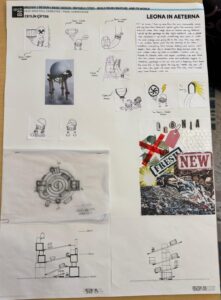
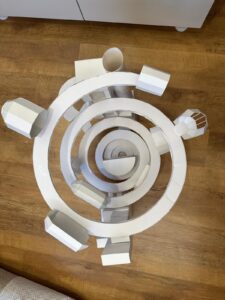
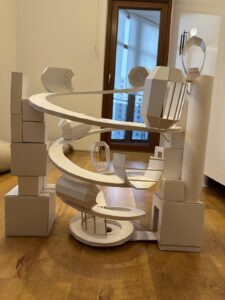
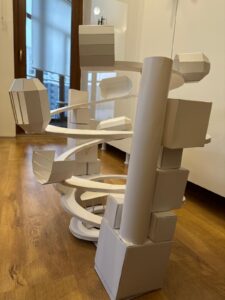
Aeterna is a radical architectural response to the tragic fate of Leonia in Italo Calvino’s Invisible Cities—the catastrophe of being buried under its own waste. The project rejects the destruction created by the linear consumption economy and adopts the Circular Urban Metabolism model. Named after the Latin word for Eternity, this city is built on an endless spiral form that fits its name. This spiral geometry is a flow diagram where waste turns into energy and chaos turns into systemic order. Located at the heart of the city, Leona, named after the Sun, is not just a mechanical power but the main life source that feeds and lights the city.Being a user in Aeterna means being part of a never-ending transformation and a symbiotic relationship. While climbing up the spiral form of the city, you experience the open, closed, and semi-open spaces where Leona is integrated into urban life. These spaces are special stations designed for Leona to maintain the urban metabolism. Leona reaches the giant waste mountains coming from Leonia from the outer edge of the city and converts this raw material into energy to feed the city with its special mesh structure in its mouth. This process is the city’s reason for existence; while Leonia consumes, Aeterna transforms.In the protected open and semi-open spaces of the spiral, Leona’s more personal and social needs are met. As a user walking along the ramp, you can observe the interaction platforms where Leona communicates with its friends, the cleaning stations where it purifies its own system, and the areas where Leona is repaired and rests in sleep mode. The tip of the spiral reaches directly to Leonia; in this way, the raw energy obtained reaches the whole city. Leona, on the other hand, returns to the beginning of the spiral through the tunnels among the waste without entering the city, and the cycle returns to the beginning perfectly every time. Defying the waste darkness of Leonia, Aeterna continues to breathe in an infinite cycle with the power it receives from its own sun, Leona. Here, architecture is not just a structure, but a living and transforming organism.