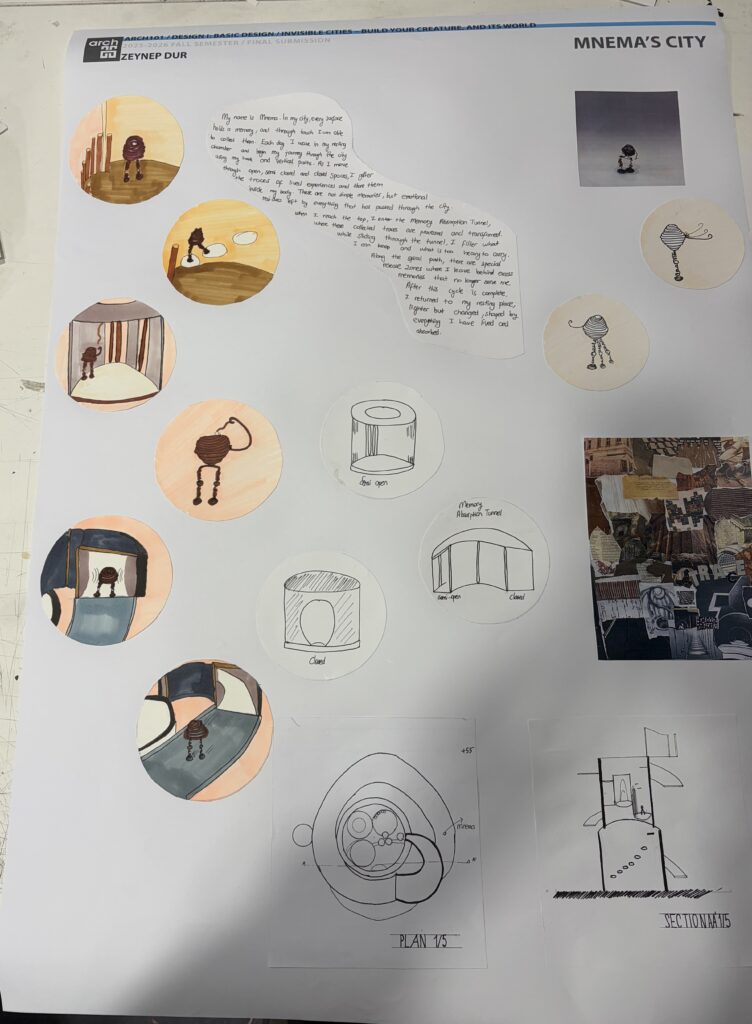
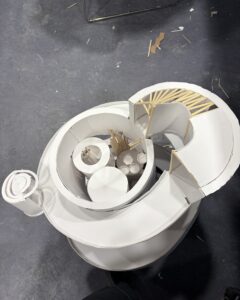
This city is conceived as a layered field of memory that resists linear time. Its spatial organization is structured around a central core, defined by a spiral path that ascends vertically through multiple layers. The spiral functions not only as a circulation element but also as a narrative device that connects past experiences to the present. Each layer of the city represents a distinct emotional state and moment of everyday life, allowing memory to be embedded within space. As the layers rise, the spaces gradually shift from dense and grounded to more abstract and purified. Moving through the city is a creature whose role is to collect and internalize the memories stored within each spatial layer. As it travels along the spiral route, the creature encounters different atmospheres: loss, tension, calmness, and hope. Each space leaves an imprint on the creature, transforming it as it continues its journey. Upon reaching the highest point, these fragmented memories are synthesized into a single essence. The central void of the city becomes a silent threshold where accumulation and release coexist. Spatially, the city is defined through the balance of solid and void, open and closed, heavy and light elements. The spiral path and central zones are constructed as three-dimensional structures, encouraging movement not only horizontally but also vertically. This spatial complexity enhances the experiential depth of the city. Light penetrates through the layers, reinforcing the immaterial quality of memory and emphasizing the transition between different zones. Everyday life within this city unfolds slowly and deliberately. Users do not simply move from one place to another; instead, they transition between emotional states. The city operates as a living memory organism, where experiences are not erased but preserved, transformed, and continuously reinterpreted through spatial interaction.