ARTICULATED MEMORY / BATUHAN ŞEN
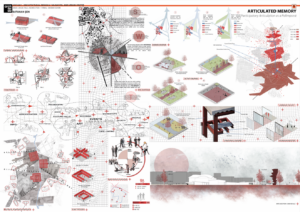
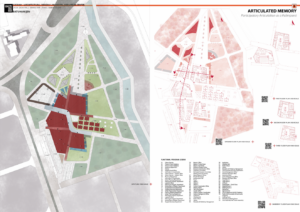
This project conceives architecture as a living palimpsest, where time is not stacked vertically but experienced horizontally through space. The building is structured around four spatial layers representing the Seljuk, Ottoman, Republican, and Contemporary periods of Sivas. These layers are not literal reconstructions; instead, the plan typologies of each era are reinterpreted, allowing historical traces to be sensed through spatial organization, movement, and scale.
The remnants of these typologies generate a plan choreography that guides the formation of new spaces. As users move through the building, they engage with a continuous dialogue between past and present, where history is not displayed but inhabited. This approach transforms memory into an active spatial experience rather than a static reference.
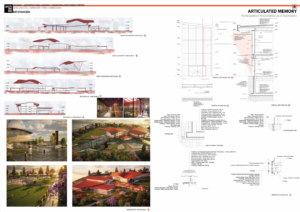
A key architectural gesture is the building’s intersectional cut oriented toward the southeast, responding to Sivas’s prevailing northwest wind. This strategic orientation disrupts dominant air flow and, together with a lower-ground entry, establishes a stable and natural air circulation throughout the interior. Environmental performance thus becomes an integral part of the architectural narrative.
Binding all historical layers together is a connective contemporary layer that hosts shared spaces, circulation, social areas, and recreational zones. Acting as both a physical and symbolic mediator, this layer links historical strata with contemporary civic life. It is where participation, interaction, and collective use become visible and spatially articulated.
Ultimately, the project seeks to rewrite the city’s historical memory through continuous spatial dialogue. The building is envisioned as a participatory architectural organism—an evolving structure in which multiple eras coexist, interact, and adapt, forming a renewed and collective urban narrative.