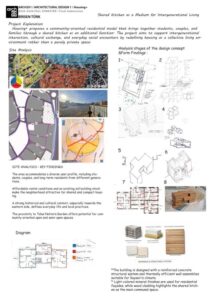
This project proposes a Housing+ model that explores intergenerational living through shared domestic spaces, with a particular focus on the collective kitchen as a social and spatial medium. The project is located on the edge of Talas Nation’s Garden, an area characterized by a strong historical context, affordable housing conditions, and a diverse social structure that includes students, couples, families, and long-term elderly residents.
Site analysis revealed that although different generations coexist physically within the neighborhood, daily social interaction between these groups remains limited. Students often experience time constraints and limited domestic facilities, while elderly or middle-aged residents may face challenges related to cooking alone or maintaining daily routines. In response to these findings, the project introduces a shared kitchen as an additional communal function that supports everyday interaction, mutual support, and cultural exchange.
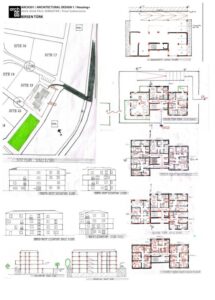
The architectural design integrates three different housing typologies—family units, couple-oriented units, and shared student housing—within the same residential structure. These units are organized around shared spaces, allowing private living environments to coexist with collective areas. The shared kitchen is positioned on the ground floor and directly connected to open and semi-open spaces, reinforcing its role as the social core of the project. Rather than functioning solely as a cooking area, the kitchen becomes a place of learning, interaction, and informal knowledge transfer, particularly through traditional and contemporary culinary practices.
From a material and structural perspective, the project employs a reinforced concrete frame system suitable for Kayseri’s continental climate. Gas concrete blocks combined with stone wool insulation enhance thermal performance, while light-toned mineral finishes contribute to energy efficiency. Wood cladding is specifically used in the shared kitchen area to emphasize its communal identity and create a warm, human-scaled atmosphere.
Overall, the project reinterprets housing as a collective and cultural experience rather than a purely private dwelling. By integrating shared domestic practices into architectural design, Housing+ aims to strengthen community bonds and support inclusive, intergenerational living.