Terrace House is a mixed-use residential project that explores the concept of vertical living enriched with generous outdoor spaces. The main design intention is to redefine dense urban housing by integrating private terraces into each residential unit, allowing residents to maintain a strong connection with open air, daylight, and greenery within a compact city context.
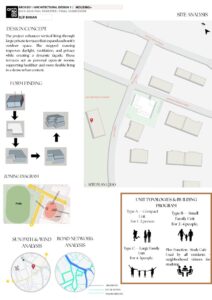
The project is located on an urban plot with direct access to major and local roads, ensuring easy pedestrian and vehicular connectivity. Site analysis focused on sun path, wind direction, and surrounding circulation networks in order to optimize building orientation and massing. As a result, the stepped form of the building responds directly to environmental factors by maximizing natural light, improving cross-ventilation, and reducing visual and acoustic privacy issues between units.
The architectural form is developed through a terracing strategy, where each floor recedes to create large private outdoor spaces. These terraces function as extensions of interior living areas and act as semi-open rooms that support flexible daily activities such as resting, studying, or socializing. The stepped massing not only enhances user comfort but also creates a dynamic and contemporary façade that reflects the internal organization of the building.
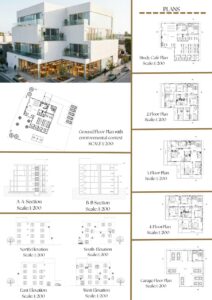
The building program consists of three main residential unit typologies: Type A units designed for one to two people, Type B units suitable for small families, and Type C units planned for larger family structures. This variety allows the project to respond to different user profiles and housing needs. In addition to residential functions, a study café is located on the ground floor. This semi-public space serves both residents and neighborhood users, encouraging social interaction and activating the street level.
Overall, Terrace House aims to provide a sustainable, user-oriented housing model that balances density with quality of life. By combining environmental design strategies, flexible unit typologies, and shared social spaces, the project proposes a contemporary approach to urban residential architecture.