URBAN AGORA / KHADIJAH Y.JAMARIS
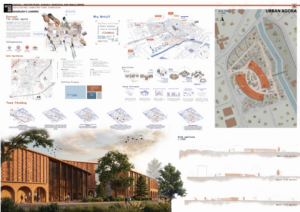
The Sivas Municipality Hub or the “Urban Agora”, aims to be a contemporary civic ground where governance, culture, and everyday urban life intersect. Historically, the agora functioned as a space of assembly, dialogue, and collective decision-making. In Sivas, where civic participation has increasingly felt distant from the physical fabric of the city, the project reintroduces this spatial condition as an open and inclusive platform for encounter, exchange, and co-production.
Rather than operating as a closed administrative building, the hub positions itself as a public civic landcape. It invites citizens of Sivas not only to access municipal services, but to inhabit, negotiate, and contribute to the city together. The project challenges the notion of citizenship defined solely through productivity and labor, proposing instead a civic space where social interaction, cultural expression, and collective presence are equally valued. Through this approach, the building becomes a mediator between institutions and people, fostering transparency, dialogue, and shared ownership.
Central to the project is the use of pocket spaces. Small, flexible, and interconnected areas are distributed throughout the building. These spaces (terraces, small courtyards, and porticoes) function as places for informal gatherings, public discussions, workshops, exhibitions, and spontaneous cultural events.
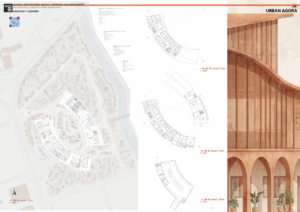
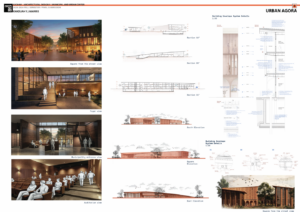
Architecturally, the hub is composed of two primary buildings: the Municipality Building and the Socio-Cultural Hub. The Socio-Cultural Hub acts as a vessel of Sivas’s collective identity, housing workshops—particularly metal workshops that reference the city’s industrial and railway heritage—alongside a performance hall, youth center, and city museum. It functions both as a space for preserving and transmitting local traditions, stories, and crafts, and as a platform for generating new cultural expressions through contemporary practices.
The Municipality Building acts similarly by positioning public-facing functions on the ground floor. Cafés, multipurpose halls, a senior lounge, and a youth incubator create accessible spaces for informal encounters, dialogue, and civic participation providing shared urban experiences for its people.
The two buildings are interconnected through a sequence of courtyards and plazas, designed as flexible landscapes. These open spaces can adapt to seasonal and everyday uses, functioning as markets, exhibition grounds, or picnic areas.Finally, the roof of the Socio-Cultural Hub gently slopes down to the ground, allowing people to walk across it and offers elevated views toward the river and the city.