CADENCE / İCLAL YETER
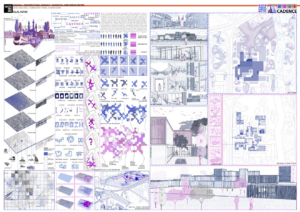
Sivas is a city that does not live in a single rhythm, but in a dual pulse. In winter, it is quieter and more introverted, defined primarily by its local community. In summer, its population nearly doubles; the city becomes active, open, and socially expanded. This seasonal shift is not only a matter of climate or density, but a transformation that is simultaneously social, economic, and spatial. The project interprets this transition as an architectural language.
The guiding concept of the design is cadence. In music, cadence is the moment where phrases come together — a pause, a resolution, or a connective moment that allows the composition to continue. In this project, cadence becomes the spatial equivalent of coming together, holding, releasing, and reconnecting within the urban life of Sivas. Public life is translated into a sequence of spatial rhythms rather than a single fixed form.
Squares, inner streets, semi-open courtyards, and adaptable public voids operate as urban cadence points. These spaces organize a diverse program that includes municipal service units, a sports hall, childcare facilities, education and exhibition spaces, production and development areas, conference halls, a city museum, and small-scale retail units. Each function is positioned according to its required level of accessibility, intensity, and temporality, allowing different rhythms of use to overlap throughout the day and across seasons.
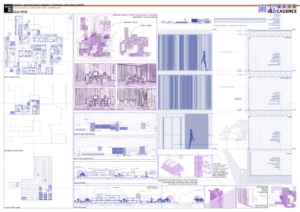
Municipal services, retail units, and exhibition spaces are primarily located at the ground level, forming an active public interface with the city. Childcare areas, sports facilities, and education spaces are placed in close proximity to open courtyards, supporting both controlled and spontaneous social interaction. Upper levels accommodate conference halls, production and development spaces, and administrative units, where spatial sequences gradually slow down and become more focused.
Rather than resisting change, the architecture embraces it, forming a living structure that breathes with the city’s seasonal rhythm. Vertical circulation cores and semi-transparent envelopes reinforce moments of transition, pause, and movement. Facade elements, particularly perforated metal panels, filter light and visibility, allowing the building to respond to time, climate, and use. The built environment becomes a rhythmic composition a spatial score where public functions connect like musical phrases through moments of cadence.