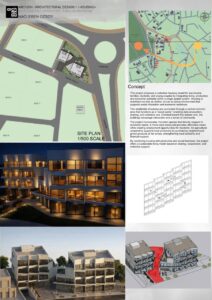
Faceted Spine Housing proposes a collective living model that reinterprets housing typology not solely as a shelter function, but through the concepts of shared circulation, social interaction, and economic solidarity. The project aims to create an accessible, sharing-oriented, and sustainable residential environment for low-income families, students, and young couples.
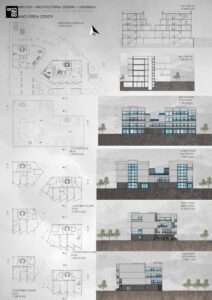
The project site is located at a point characterized by intense urban activity and the intersection of multiple transportation axes. In this context, the building is conceived not as an isolated housing block, but as an integrated system that establishes a strong relationship with the city and contributes to public life. Two main residential masses are positioned to create a strong spatial relationship between them, forming a centrally defined circulation space. This central circulation space, which constitutes the main design concept of the project, is structured around the idea of a “spine.” The spine functions not only as a physical connector between the buildings but also as a social space that enables encounters, interaction, and shared use among residents. The circulation scheme is organized around this spine, allowing collective living to be continuously perceived at a spatial level.
The triangular and fractured surfaces used in the façade design define the “faceted” character of the building. This faceted configuration creates rhythm and depth on the façade while enhancing the building’s dynamic perception through light and shadow relationships. At the same time, the façade geometry makes the internal circulation and spatial movement legible from the exterior.
Semi-public and productive functions located on the ground floor support the project’s economic and social sustainability. A home-style restaurant provides affordable meal services while creating employment opportunities for residents. In addition, the agricultural cooperative space is designed to monitor and organize products produced by local residents, grouping them and offering them for sale through a local market established on specific days of the week. This system aims to revitalize the neighborhood economy and strengthen local solidarity.
In conclusion, Faceted Spine Housing brings together a central circulation system and a faceted façade articulation to propose an alternative housing model based on sharing, interaction, and collective living.