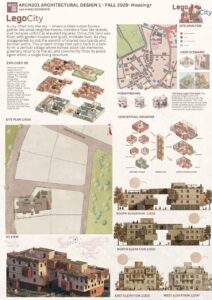
Once, talas was composed of small houses with gardens, where daily life unfolded close to the ground and social bonds were formed through everyday encounters. As these houses were replaced by taller, denser buildings, not only the physical fabric but also a shared way of living was lost. This project begins with that absence. It proposes a prefabricated social housing complex conceived as a city within a building, where the social memory of the site is reinterpreted through a contemporary, vertical form.
The design is informed by a LEGO city logic, where small, repeatable elements come together to create a larger, dynamic whole. Prefabricated modular units act as building blocks that are stacked, shifted, and combined to form micro-neighborhoods, internal streets, and social corridors. Rather than appearing as a single monolithic mass, the building reads as an assemblage — flexible, adaptable, and human in scale. Shared terraces replace private gardens, while circulation spaces become active social zones that recreate the rhythms of neighborhood life.
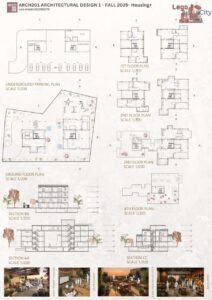
At ground level, the project opens itself to the city through public and semi-public spaces, including an outdoor sunken amphitheater that serves as a communal gathering space for performances, meetings, and informal use. Social functions such as a café, swap store, and daycare further activate the ground floor and strengthen community interaction. The landscape is organized as a sequence of plazas, gardens, and pedestrian paths, extending the idea of streets and squares into the open space.
At the top floor, a shared cooking and dining space becomes a collective destination, bringing residents together around food and daily rituals. Supported by the efficiency and flexibility of prefabrication, the project offers a socially rich model of dense housing — one that transforms memory into architecture through a contemporary, modular city.