SUB-URBAN / HALE TAT
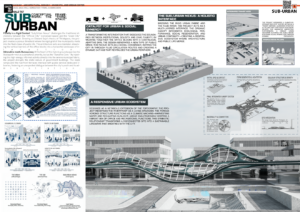
Stitching the City and River Located at the critical intersection of Sivas’ rigid urban grid and the fluid river landscape, SUB URBAN operates not merely as a building, but as a multi-layered interface. The project challenges the disconnect between the city center and its periphery, aiming to dissolve the physical boundaries that separate the urban fabric from the waterfront. It transforms this transition zone into a vibrant public destination.
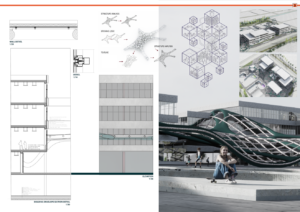
The Organic Spine: A Unifying Canopy The design is defined by a continuous, organic Voronoi canopy that functions as the project’s structural and conceptual spine. This semi-permeable skin creates a transition zone, visually and physically linking the fragmented office blocks into a cohesive campus. Beyond aesthetics, the canopy acts as a climatic machine; its porosity regulates sunlight to create a comfortable microclimate, while its structural legs serve as hydrological funnels, harvesting rainwater for underground cisterns to irrigate the landscape.
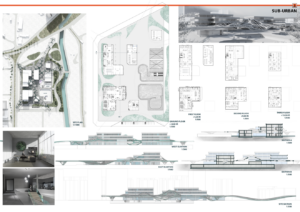
Social Catalyst & Hybrid Functions Breaking the monotony of traditional office typologies, SUB URBAN dedicates its ground plane entirely to civic engagement. The program integrates a climate-responsive bus stop—acting as a transit gateway—and a dynamic urban skatepark, which utilizes the site’s topography to attract youth and energize the public realm 24/7. These active zones are woven together by the canopy, ensuring that the space remains a social condenser even outside of office hours.
Sustainability & Future Vision By merging high-tech structural solutions with passive ecological strategies, SUB URBAN proposes a new model for development in Sivas. It demonstrates how architecture can act as a responsive ecosystem, balancing the needs of the environment with the demands of social interaction, ultimately giving the city a new, sustainable landmark.