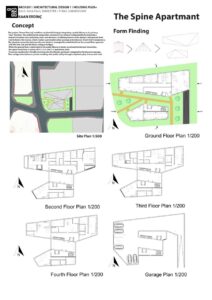
Concept and Urban Integration The project “House Plus-ing” redefines contemporary residential living by integrating a public library as its primary “plus” function. The design philosophy centers on balancing private dwelling with public utility through a rhythmic play of mass and void. A defining feature of the architectural composition is the ground-level void between the primary masses, which creates a permeable urban passage and enhances street-level transparency. This strategy allows the building to act not just as a residence, but as an active participant in the urban fabric.
Architectural Composition and Circulation The building consists of two distinct residential blocks linked by a central circulation core that houses the primary stairs and elevators. While the masses remain separated at the ground level to facilitate the urban passage, a physical connection is strategically established from the second floor upwards. The second, third, and fourth floors act as structural and functional bridges, creating a unified architectural form that floats above the public realm.
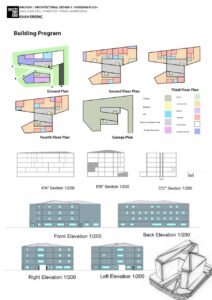
Program and Functional Organization The building program is vertically stratified to manage the transition from public to private spaces:
Ground Floor: Dedicated entirely to the public library to foster social and intellectual interaction within the community.
Upper Levels (2nd–4th Floors): Host a diverse variety of residential offerings, including 1+1, 2+1, and 3+1 apartment units to accommodate different family structures.
Basement: To ensure a pedestrian-friendly environment at the street level, all vehicular parking is relegated to a dedicated basement garage.
Through this configuration, the project successfully harmonizes the privacy required for modern housing with the accessibility of a vital public resource, utilizing the library as a bridge between the residents and the surrounding city.