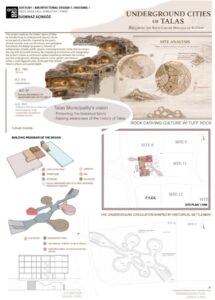
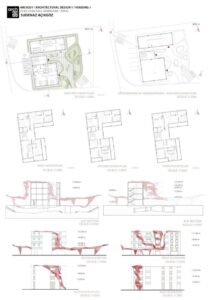
Palimpsest Talas proposes a Housing Plus model in Talas, Kiçiköy Neighborhood, where contemporary living is constructed as a new spatial layer written over the historical underground city of Talas. The project is grounded in the concept of palimpsest, understanding architecture as a condition in which past and present coexist, allowing multiple spatial and temporal layers to be read simultaneously.
Rather than reproducing the underground city as a literal form, the project reinterprets its existing typologies, such as linear continuity, directional movement, and layered spatial organization. These principles shape both the underground spaces and the architectural decisions above ground. In this sense, the underground city becomes the primary generative layer upon which the new housing structure is written—without erasing its presence or logic.
The design establishes a strong vertical and conceptual continuity between underground and surface through a layered architectural system. This continuity extends into the roof and landscape, which follow the same directional logic as the underground city. The roof surface becomes an active architectural element, merging with the underground ceiling at specific entrance and exit points. These intersections are intentionally designed to create a gradual transition between levels, reinforcing the perception of descent while offering a more inviting and legible access to the underground spaces.
The plus function of the project is an Underground Cities Research Center, positioned as a public interface that increases awareness of Talas’ hidden heritage. This research center transforms the underground from a concealed historical layer into an accessible and educational environment, bridging academic research and public engagement.
By integrating housing with a research-oriented public program, the project blurs the boundaries between private and communal spaces. Palimpsest Talas ultimately redefines housing as an architectural mediator—one that sustains cultural memory while allowing contemporary life to unfold as a new, readable layer within the ongoing spatial narrative of Talas.