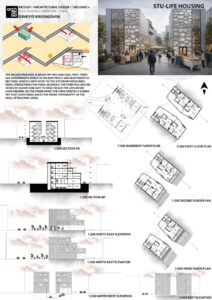
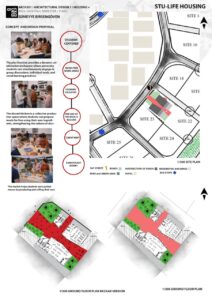
This project is located in the Talas district of Kayseri, between Old Talas and the Talas Millet Garden area, and is shaped by the idea of building a bridge between historical fabric and contemporary life. The selected site has the potential to bring together different user profiles, thanks to its proximity to both Old Talas, which bears the traces of the past, and Millet Garden, one of the important focal points of modern urban life.
When making settlement decisions for the project, the location of existing vehicle roads in the area, solar orientation, pedestrian movements, and public accessibility were considered fundamental criteria. Accordingly, vehicle traffic and pedestrian movements were separated as much as possible; pedestrian entrances were defined taking into account solar orientation and street relationships. Thus, the structure establishes a strong and controlled relationship with its surroundings.
The building has a mass organization consisting of two blocks. On the ground floor, both blocks feature building entrances and acoustic work areas. This decision allows the ground floor to take on a more public and dynamic character while also protecting the privacy of the residential areas on the upper floors. The main axis created between the two blocks is one of the most important spatial decisions of the project. This axis is not merely a passageway; it is designed as a defined circulation backbone for pedestrians. On a specific day of the week, this axis transforms into a market area where students can sell products they have made by hand. Thanks to this transformation, the area gains the character of a small-scale square that increases social interaction and brings users together. Thus, the project responds not only to the need for shelter but also to the need for socialization and public life.
The residential units located on the upper floors are designed as affordable rental apartments, particularly targeting students. This decision was made considering the high concentration of students in the Talas region, aiming to create an economical, accessible, and functional living space. The layout of the apartments is organized to maximize the benefit of natural daylight. The facade design employs reinforced concrete structures in a modern language; light-transmitting bubble-shaped glass facade cladding ensures that the interior spaces are bathed in natural light. These facade elements both reinforce the building’s identity and contribute to making the structure a focal point in its surroundings by creating different perceptions day and night.
Ultimately, the project proposes a contemporary living space that brings together the concepts of housing, public space, social interaction, and urban continuity, establishing a strong relationship with its context and forming a spatial and social bridge between Old and New Talas.