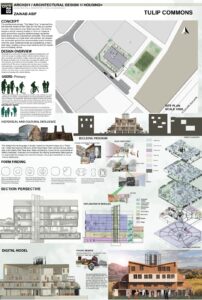
“Tulip Commons” is a residential housing project deeply rooted in a dual conceptual framework: the organic symbolism of the tulip, a significant cultural icon in Turkish history and the geometric rigor of Seljuk architecture. The design aims to harmonize historical reverence with contemporary living standards. Drawing inspiration from the local heritage of Kayseri, particularly the Seljuk period, the proposal references the masonry logic, materiality, and volumetric strategies of historic structures found in the region.
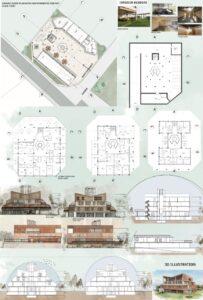
The form of the building emerges from a rigorous geometric process. Beginning with a strong octagonal footprint that is a nod to traditional Islamic and Seljuk geometric patterns and the massing is carefully sculpted in response to its urban context. A central atrium is carved from the volume, while the upper levels are stepped back to reduce visual mass and avoid a monolithic presence. This subtractive strategy results in a “breathing” building, unified by a distinctive skylight that draws natural daylight through all floors, strengthening spatial continuity and enhancing interior environmental quality.
The building envelopes further mediate between tradition and modernity. The facade is articulated through perforated terracotta tiles inspired by Seljuk ornamental screens and masonry traditions. Backlit at night, these elements create a layered play of light and shadow, establishing a strong visual identity. Cascading terraces are embedded within the facade composition, providing private outdoor spaces for residents while softening the building’s silhouette against the sky.
The project is designed to serve a diverse user group. The primary users include elderly residents, students from Kayseri University and Erciyes University, couples, roommates, and families, allowing for an inclusive residential environment that accommodates different lifestyles and age groups. The secondary users consist of residents from the surrounding neighborhood, who are invited to access the building’s public amenities. These facilities are strategically located on the ground floor to ensure ease of access and encourage interaction between the building and its urban context.
Accordingly, the ground floor is dedicated to public and semi-public “plus functions” that extend beyond the residential community. These include a daycare, a mosque that is particularly accessible for elderly users during harsh weather conditions, study areas for students, and a playground for children. By opening these functions to the street, the project operates as a neighborhood asset, strengthening social integration and ensuring that Tulip Commons benefits not only its residents but the wider urban fabric of Kayseri.