Hexa-North: The Interstellar Portal
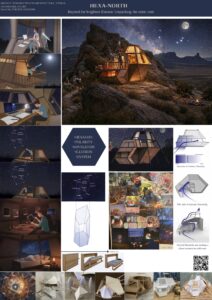
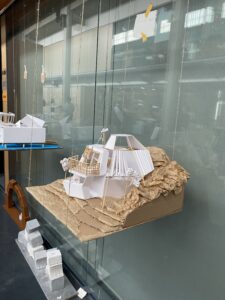
The concept of Hexa-North emerges from a personal childhood memory about observing the night sky. Like many, I grew up thinking Polaris was the brightest star. However, learning about the Winter Hexagon—a large asterism that outshines Polaris—changed my understanding of the sky. This shift from focusing on a single point to discovering a larger, complex geometry forms the foundation of my Escapecore project. The retreat is a spatial translation of this realization, located on a steep rocky topography that naturally directs the user’s gaze upward. The architecture physically reflects this transition from the ground to the sky. The structure starts with a solid foundation embedded in the rock, creating a secure and isolated environment. As it rises, the design becomes lighter, ending in an asymmetrical hexagonal roof. This roof is not just a structural element; it acts as a specific architectural lens. I calculated and oriented the hexagonal canopy to directly frame the Winter Hexagon, turning the building into an observation tool rather than just a shelter. Everyday life in Hexa-North is organized around this vertical spatial journey. During the day, the user spends time in the lower level, which is designed as a quiet workspace and an analog photography darkroom. Here, disconnected from the fast pace of daily life, they can focus on developing photographs and personal reflection. At night, the routine moves to the upper level. The user climbs a compact staircase to the mezzanine, bringing them directly under the hexagonal roof. By manually opening the canopy, they can observe the Winter Hexagon, turning a childhood memory into a daily spatial experience.
Celestial Nexus
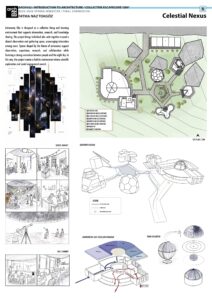
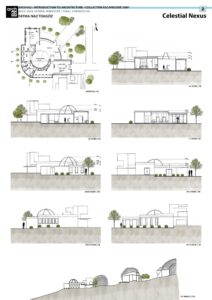
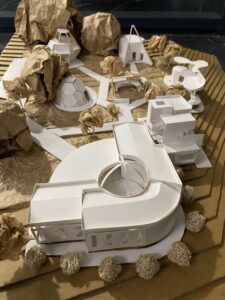
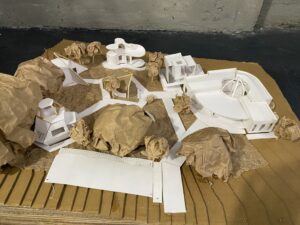
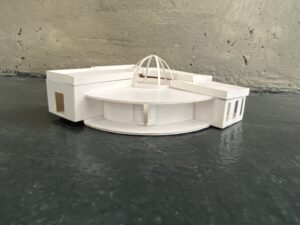
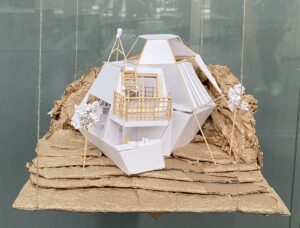
Celestial Nexus is an astronomy-themed gathering area designed to bring together five oba members within a collective settlement. The project is based on the idea that knowledge is not produced individually but through observation, research, discussion, and collaboration. Each member contributes to the community through a different role, creating a system that supports the production, development, and sharing of astronomical knowledge. The project consists of shared spaces for working, discussion, experience, and observation. While one member manages books and educational resources through the Knowledge Hub, the others focus on research and observation activities. Shared workspaces, discussion areas, and observation zones allow members to exchange ideas, evaluate their findings, and learn from one another. The spatial organization is designed to strengthen these relationships and bring together different roles around a common purpose. The project also creates a connection between the oba community and visitors. Through exhibition and experience areas, visitors are invited to explore astronomy in an interactive way. They can examine space-related objects, participate in hands on activities, and gain new knowledge through observation. In addition, immersive experiences such as virtual reality environments help visitors engage with astronomy from different perspectives. In this way, the knowledge produced within the oba becomes accessible to a wider audience. As an oba member, my day begins in my own living space. I review my observations, organize my notes, and prepare for the day’s work. Later, I meet the other members in the shared workspace, where we discuss our research and develop new ideas together. Throughout the day, research, observation, and collaboration shape our activities. While visitors explore the exhibition and experience areas, we continue our studies and share our findings. In the evening, we gather in the observation area to observe the night sky together, ending the day as a community. Celestial Nexus is not only a research environment but also a community space where knowledge becomes a shared experience and different perspectives come together to support learning and discovery.