ARCH201-ARCHITECTURAL DESIGN 1- HOUSING+
NAME-SURNAME: ASLI GÜNEŞ
LIVING LIBRARY
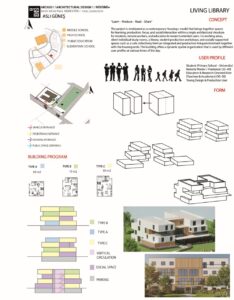
Living Library is a Housing+ project located in Kayseri, developed in response to the high concentration of educational buildings in its immediate surroundings. The project aims to redefine housing not merely as a space for accommodation, but as an active living environment that integrates learning, production, working, and social interaction into everyday life.
The main concept of the project, “Learn-Produce-Read-Share,” directly shapes both the programmatic organization and the architectural form. Instead of separating residential units from public or semi-public functions, the design proposes an integrated and interwoven form in which housing and plus functions coexist. This approach establishes a continuous relationship between daily life and knowledge-based activities while strengthening the project’s connection to its educational context.
The program includes housing units of different sizes (Type A, B, and C) combined with shared functions such as a library, co-working spaces, silent individual study areas, meeting rooms, student production/workshop spaces, and a cafe. This spatial diversity supports multiple user profiles, including students, remote workers and freelancers, education- and research-oriented users, as well as young designers and producers, allowing them to share the same architectural framework.
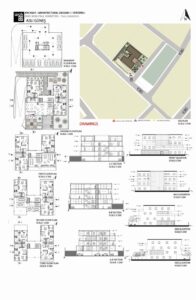
Architecturally, the project is designed to be perceived as a single cohesive mass, where residential and shared functions are spatially connected rather than isolated. Public and semi-public spaces are positioned to encourage interaction and collective use, while housing units maintain privacy through spatial hierarchy and controlled circulation. Terraces and open spaces extend the idea of the library beyond enclosed interiors, offering informal areas for reading, meeting, and socializing, and reinforcing the concept of a “living library.”
In conclusion, Living Library proposes a contemporary Housing+ model that responds to its educational surroundings by integrating living, learning, and production within a unified architectural structure. The project supports collective use and knowledge sharing while preserving residential comfort, offering a balanced and productive living environment.
ARCH201-ARCHITECTURAL DESIGN 1- HOUSING+
NAME-SURNAME: ASLI GÜNEŞ
LIVING LIBRARY
Living Library is a Housing+ project located in Kayseri, developed in response to the high concentration of educational buildings in its immediate surroundings. The project aims to redefine housing not merely as a space for accommodation, but as an active living environment that integrates learning, production, working, and social interaction into everyday life.
The main concept of the project, “Learn-Produce-Read-Share,” directly shapes both the programmatic organization and the architectural form. Instead of separating residential units from public or semi-public functions, the design proposes an integrated and interwoven form in which housing and plus functions coexist. This approach establishes a continuous relationship between daily life and knowledge-based activities while strengthening the project’s connection to its educational context.
The program includes housing units of different sizes (Type A, B, and C) combined with shared functions such as a library, co-working spaces, silent individual study areas, meeting rooms, student production/workshop spaces, and a cafe. This spatial diversity supports multiple user profiles, including students, remote workers and freelancers, education- and research-oriented users, as well as young designers and producers, allowing them to share the same architectural framework.
Architecturally, the project is designed to be perceived as a single cohesive mass, where residential and shared functions are spatially connected rather than isolated. Public and semi-public spaces are positioned to encourage interaction and collective use, while housing units maintain privacy through spatial hierarchy and controlled circulation. Terraces and open spaces extend the idea of the library beyond enclosed interiors, offering informal areas for reading, meeting, and socializing, and reinforcing the concept of a “living library.”
In conclusion, Living Library proposes a contemporary Housing+ model that responds to its educational surroundings by integrating living, learning, and production within a unified architectural structure. The project supports collective use and knowledge sharing while preserving residential comfort, offering a balanced and productive living environment.