Urban Alley
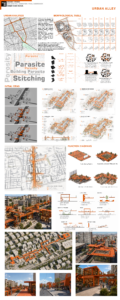
Urban Alley investigates how a fragmented urban corridor can be reconnected through a new public layer inserted between existing buildings, streets, and everyday movements. The project begins from the observation that large-scale arterial roads and rigid urban blocks often produce rupture: they separate neighborhoods, weaken pedestrian continuity, and reduce the street to a line of transit rather than a shared civic space. Instead of treating this condition as a problem to be erased, the proposal works with the existing fabric and introduces a parasitic orange structure that slips into its gaps, attaches to leftover edges, and stitches disconnected fragments together.
The intervention operates as an elevated public spine, but it is not only a bridge. It becomes a sequence of platforms, thresholds, terraces, stairs, pockets of landscape, and small programmatic insertions. These elements allow the street to be experienced at multiple levels, transforming movement into encounter. The tram corridor remains visible and active below, while the new layer creates alternative pedestrian flows above and around it. In this sense, the project redefines infrastructure as a social and spatial device.
The orange form is deliberately bold. Against the neutral and dense urban background, it acts as both a marker and a connective tissue. It highlights the possibility of a new public life emerging from within the existing city rather than being imposed from outside. Its parasitic character is not destructive; it is adaptive, relational, and responsive. It grows where the city allows it, creating new attachments between buildings, open spaces, and users.
Urban Alley therefore proposes a spatial strategy of stitching, layering, and activation. It transforms the alley, the edge, and the overlooked interval into productive urban spaces. The project imagines the city not as a finished object, but as a living field that can be reoccupied, reinterpreted, and reconnected.