EATSCAPE
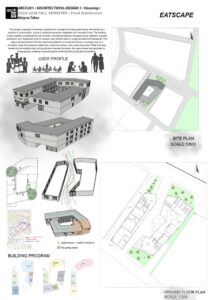
This project proposes a housing + gastronomy concept that approaches gastronomy not merely as a consumption-oriented program, but as a spatial process intertwined with production, education, and everyday life. The building is structured as a multi-layered organization that brings together diverse user profiles. Its program includes a professional main kitchen, educational kitchen workshops for gastronomy training, a publicly accessible restaurant, an open dough and baking area visually connected to the restaurant, allowing users to observe the production process, as well as residential units designed in multiple typologies.
The project defines a total of six housing types, accommodating single residents, couples, nuclear families, and gastronomy students attending short-term educational programs. Residential units designed for students respond to temporary accommodation needs through compact and flexible layouts, while other housing types support long-term living through more stable spatial configurations. All residential units are located on upper levels, gradually separating living spaces from public and productive functions and establishing a clear yet permeable hierarchy between public and private domains.
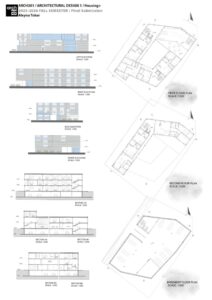
The building is composed of two interlocking blocks positioned between two urban street fronts, aiming to activate and connect both edges. The space formed between these blocks is conceived not as a courtyard, but as a dynamic circulation zone that narrows and expands, guiding movement while encouraging visual interaction and social encounters. The entrance sequence is intentionally constricted, creating a sense of selectivity and curiosity, and gradually opens toward interior public spaces, where culinary production and social activities become visible.
While the lower levels concentrate public and production-oriented gastronomic functions, the upper levels are dedicated to housing. Through this vertical layering, the project establishes a spatial continuity from production to dwelling, proposing an alternative housing model in which gastronomy becomes an active and visible component of urban life.