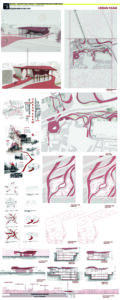
The Urban Seam project is based on the idea of creating an urban stitch that reconnects fragmented pedestrian movement, transportation flows, and public spaces within the city. The main aim of the project is to design the transportation hub not only as a technical transit point, but also as a third space where people wait, meet, orient themselves, and reconnect with the urban environment. In this sense, the red circulation lines represent the traces of movement coming from different directions. These lines act as an urban spine that stitches separated areas together and creates a readable route for users.
The map graphic in the upper-right part of the cover shows the project’s decisions at the urban scale. The fine linework represents the existing urban fabric, while the stronger red lines indicate proposed pedestrian flows, gathering points, and public continuity. Therefore, the project is considered not only at the scale of a single building, but also together with the surrounding square, transportation axes, pedestrian connections, and urban voids.
The pavilion shown in the perspective view is the architectural expression of this urban seam. Its red roof, flowing form, and organic surfaces emphasize continuity and movement. The thin columns give the structure a light, permeable, and inviting character. The strong horizontal effect of the roof connects with the red ground path, creating both direction and spatial continuity for the user.
The mosque silhouette in the background refers to the existing historical urban context. This relationship shows that the project is not only a new transportation structure, but also an intermediate space that connects with the memory of the city. A deliberate contrast is created between the modern pavilion form and the historical surroundings. At the same time, the open public areas allow users to approach the structure from different directions.
Overall, Urban Seam proposes a design approach that activates urban voids, transforms movement into space, and turns the transportation hub into a social focal point within the city.